
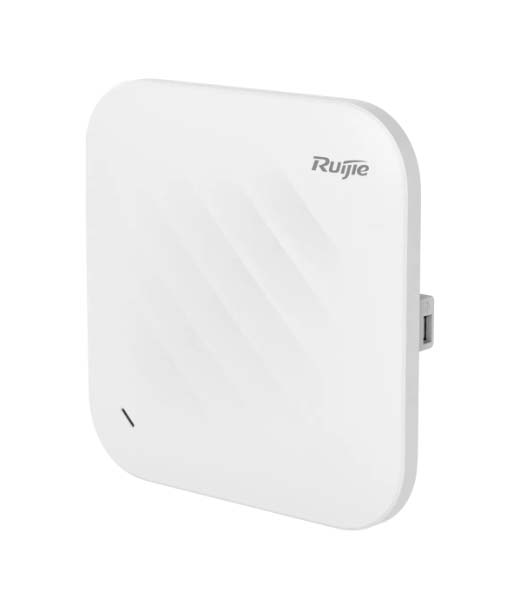
Description
Kami jual Ruijie RG-AP7176-R(V2) dengan harga terbaik di Jakarta, Indonesia. Dapatkan harga Ruijie RG-AP7176-R(V2) dengan menghubungi sales kami disini. Kami juga jual produk wireless access point lainnya baik dari Ruijie ataupun merk lain, klik disini untuk pilihan produk Wireless Access Point lainnya. Berikut penjelasan singkat mengenai Ruijie RG-AP7176-R(V2) atau untuk informasi datasheet bisa download disini.
The RG-AP7176-R(V2) is a quad-radio Wi-Fi 7 access point (AP) launched by Ruijie Networks for indoor scenarios in various sectors covering higher education, government, general education, and business. In compliance with IEEE 802.11be, IEEE 802.11ax, IEEE 802.11ac Wave2, IEEE 802.11ac Wave1, and IEEE 802.11n standards, the RG-AP7176-R(V2) adopts a hardware-independent quad-radio design and delivers a combined peak data rate of 17.982 Gbps, eliminating the performance bottleneck.
The RG-AP7176-R(V2) integrates Ruijie AI radio design. The additional intelligent radio enables real-time full-band scanning, ensuring high security and superior user experience in the Wi-Fi environment.The RG-AP7176-R(V2) is designed considering factors such as wireless network security, radio control, mobile access, QoS, seamless roaming, and Internet of Things (IoT). The RG-AP7176-R(V2) can be used together with Ruijie access controllers (ACs) and RG-WIS to implement wireless user data forwarding, security, and access control.
The RG-AP7176-R(V2) adopts a quad-radio design and complies with the next-generation IEEE 802.11be standard. When three radios are enabled, the RG-AP7176-R(V2) can provide a combined peak data rate of 17.982 Gbps, delivering high-speed access experience. The Orthogonal Frequency Division Multiple Access (OFDMA) feature in IEEE 802.11be enables the RG-AP7176-R(V2) to divide a Wireless Local Area Network (WLAN) channel into multiple sub-channels, with each client consuming one or more sub-channels. The RG-AP7176-R(V2) can implement scheduling for multiple clients to receive and send packets concurrently. This reduces contention for air interface resources and backoff, shortens network latency, and boosts network efficiency.In a high-density deployment and access scenario, the average rate per client can be increased compared to IEEE 802.11ax.


Reviews
There are no reviews yet.